Context
Our client
Smart Futures is a mission-focused non-profit software development organization based in Pittsburgh, Pennsylvania. The organization specializes in the field of career education, and they are a leading provider of online career education resources and training to schools and community-based organizations in Pennsylvania.
Smart Futures offers intuitive, well-rounded, and affordable, solutions to Pennsylvania's required Career Education and Work (CEW) standards.
More can be learned about Smart Futures by going to their website: https://www.smartfutures.org/ (opens in a new tab)
Problem
Our client has indicated that above all a successful project will address what makes work-based learning engaging and meaningful for both the providers of work-based learning (WBL) and students who are in the career learning phase. We were told that the providers of WBL will create digital content and provide information related to their career journey including the work they do and skills needed, and that his content will be engaged with asynchronously by students. Given this, we strived to determine how we can we get students to be excited about the content and return to the platform, and how can we ensure providers of work-based learning know their work is valuable so they continue to be active participants. We therefore worked to determine both feasible and impactful features which can be implemented into Smart Futures’ existing platform.
Hunt statement
Through research, Edulink will contribute to Smart Futures’ existing environment where we will support providers of work-based learning throughout an intuitive process of developing captivating content. We will utilize a virtual learning approach, to remain consistent with the requirements of Smart Futures, while also remaining in line with the PA CEW* Standards. The end system will provide an interactive experience and catalyze students’ motivation and engagement on their path of career exploration.
Timeline
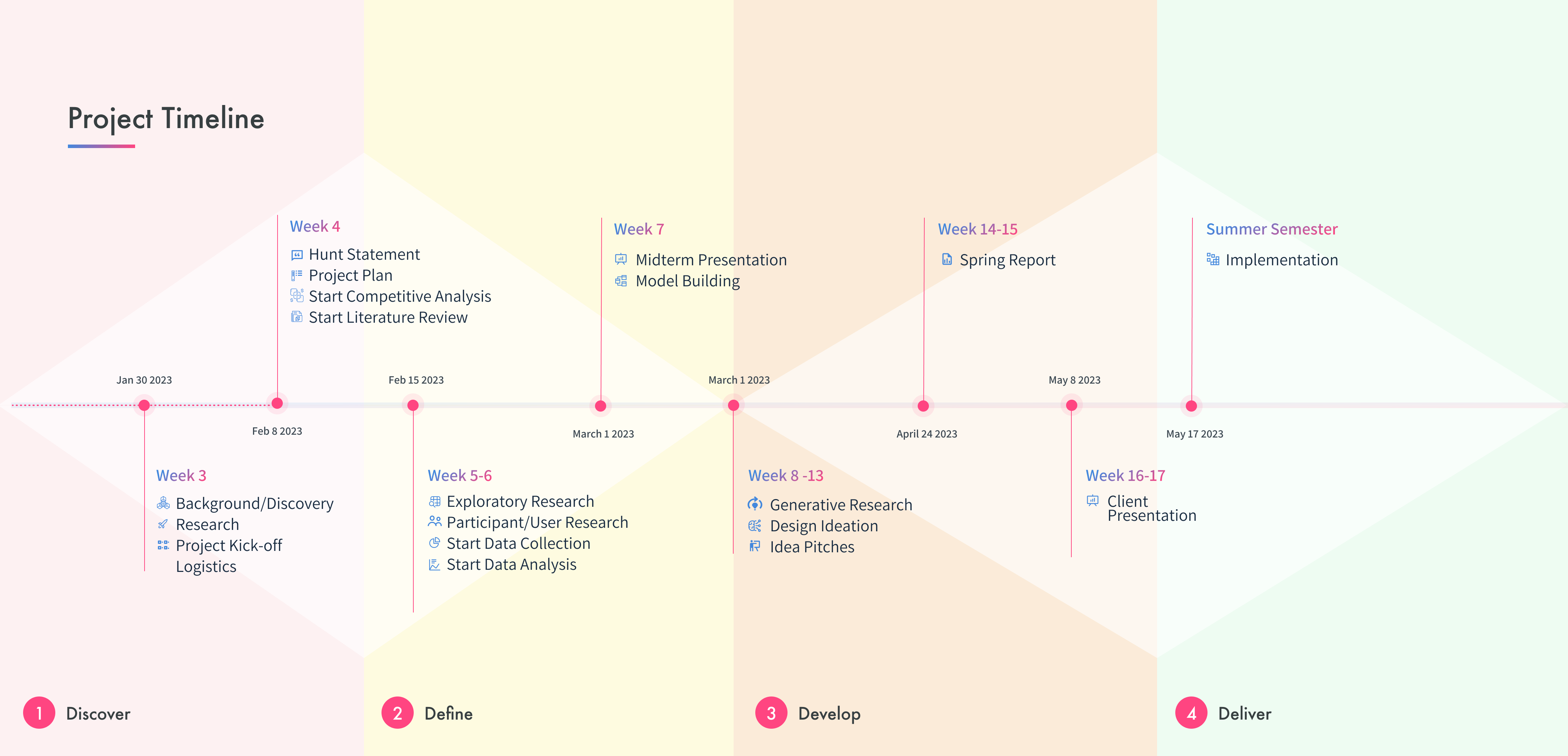
This project begins in January, 2023 and will conclude in August, extending through the Spring and Summer semesters at CMU. It follows the Discover, Define, Develop, Deliver stages to better streamline our work. By the end of summer, we would prepare the following deliverables:
- A high-fidelity Figma prototype to illustrate the user interface
- A partial front-end implementation covering two important features
These will constitute the final Capstone project deliverables and will be shared with SmartFutures as the basis for continuous design and development.